What was the point of our last episode? I’m afraid I probably wandered around, literally, in “the basement” of my thoughts, and might not have surfaced the gems: that the times of Jesus, among the wider Jewish populations, were ripe for fostering a new religion (I contrasted “religion” from “faith”, the former being a political construct, utilizing the raw human power of faith. So religions can’t be devoid of faith/ the faithful, but faith itself has nothing to do with religion. Sometimes people qualify with “organized” religion, but, to me, that is a redundancy: religion is solely organization. I might have alluded to a more recent religion – “science”™, which fundamentally is not a body of thought, rather, a mode of thinking and exploring. Somehow, probably because too many people no longer looked for/found “faith” in the traditional offerings, they began to have faith in “science”™ – an anomaly, again, because there is no faith in “science”™. In fact, a true scientists assumes that his “science”™ is false – from the beginning. Her job is to to dismantle and refute current “science”™ – belief or faith would be an insurmountable impediment to the true scientific method, although, clearly, so many scientists cling to unfounded faith! – in their own ideas and in themselves. In sum, “science”™ is a perfect example of what I am describing in these essays – how to build a religion, when there is none present.
The essence of Jesus’ time was the essence of our times: what do we believe in? In other words. religions are built on fertile soil – or maybe I should say arid soil. People need to have a grand hunger for faith – hunger breeds quick submission to dogma – hope I don’t have to give examples. In Jesus’ time there were many prophets of doom, the political structures in Judaism were rife with corruption. This is poorly understood by most Christians, and probably irrelevant to most Jews. Guarantee that those funny words like the Sanhedrin,Sadducees, and Pharisees are blanks in the Christian mind. Likewise, the political position of Herod and Pilate are completely lost.
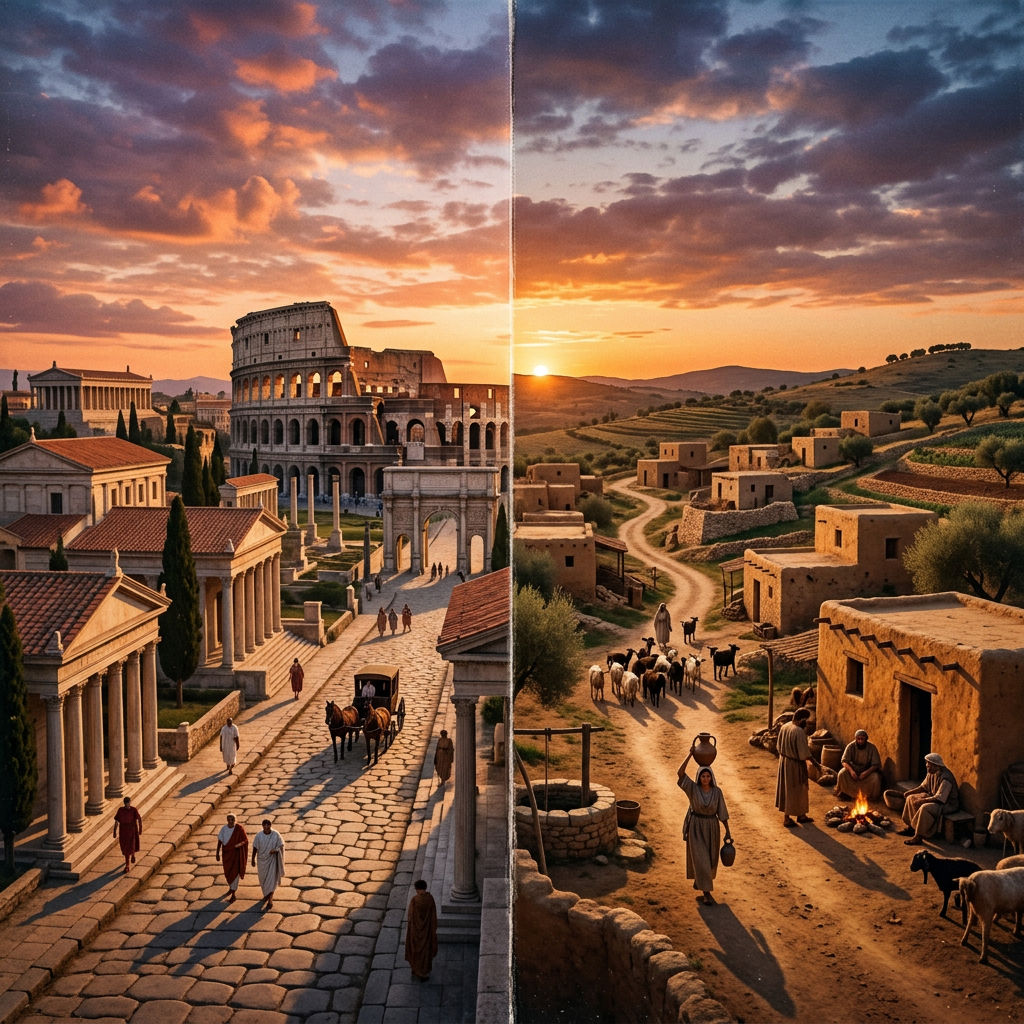
In sum:the Roman Emperor was Tiberius Caesar. Everyone below answered ultimately to Rome. Pilate was a Roman military and administrative official. His official title was Prefect (a type of governor). Pilate governed the Roman province of Judea, which was in the south. This territory included Jerusalem, Bethlehem, and the region of Samaria. Because Judea was a formal Roman province, Pilate was sent directly from Rome to collect taxes, maintain order, and command the Roman military garrison. He had the sole authority to execute criminals (which is why the Jewish religious leaders had to bring Jesus to him). Herod Antipas (son of the Herod who murdered all first-born males, when Jesus was born, in fear of later consequences) was a local Jewish potentate with the title of Tetrarch (which roughly translates to “ruler of a fourth part”). Antipas ruled Galilee (in the north, where Jesus grew up and did most of his preaching) and Perea (to the east). He was a native ruler who managed his own internal affairs, had his own local army, and collected his own taxes. However, his power was entirely dependent on staying in Rome’s good graces. This is the classic “apartheid” power pyramid: the minions are only greater than their own minions. Rome recognized the Jewish States under a very specific framework known as a Client Kingdom (or client state). 1 Rome vastly preferred not to govern difficult, rebellious frontier regions directly if they didn’t have to. Instead, they would recognize a local, loyal leader to rule the territory on Rome’s behalf. This is what Herod the Great (Antipas’s father) was—a fully recognized “King of the Jews” who ruled a massive, united Jewish state. In the Roman system of outsourcing local management, the High Priest and the Sanhedrin essentially functioned as the local, domestic government of Judea, operating directly beneath the Roman governor (Pontius Pilate). During Jesus’s trial, the High Priest was Caiaphas. While his title sounds purely religious, he was actually the most powerful native political figure in Judea. The Great Sanhedrin was an elite assembly of 71 men—composed of chief priests, scribes, and wealthy aristocrats (primarily Sadducees and Pharisees). It was presided over by the High Priest. They functioned as a combination of a supreme court, a city council, and a theological legislature. They had full authority over Jewish religious law, civil disputes among Jews, and the administration of their own local Temple police force. However, Rome drew a hard line at the death penalty. The power of the sword—the right to execute a criminal—was strictly reserved for the Roman governor. While they both sat on the Sanhedrin and held significant power, the Pharisees and the Sadducees were essentially rival political and religious parties. They represented entirely different social classes and held deeply opposed views on how Judaism should be practiced. The Sadducees were the old-money aristocracy. They were comprised primarily of the wealthy elite, the high priestly families, and the Jerusalem nobility. Their entire power base was centered on the physical Temple in Jerusalem. The Pharisees, on the other hand, were the middle class. They were businessmen, tradesmen, and religious scholars who were deeply popular with the common working people. Rather than focusing exclusively on the Temple, their power base was in the local synagogues.
In critical information theory, the requisite for comprehending “information”, is first, to examine the underlying power structures. The goal of religion – or any political movement – is to obscure any relation to power, by a kind of reductionism2 : the power structures are “listed”, plain for all to see, but just a list. The complex interaction of the list members, and the ripple-effect of the movement of power, is hidden – purposefully.
The point – the big point – is that Jesus was considered a “radical” 3 But if we are examining this through the critical lens, and the dense mist of history that has been used to cloak the actual truth, we can’t be sure that Jesus was perceived in such a grandiose way – the lone rebel leader against the (Jewish) empire.4 Ultimately, Jesus “fit the bill” for a later, more concerted movement, to overthrow the client state regime of those like Herod or the Sanhedrin. The members of the Sanhedrin (the high priests, Pharisees, and Sadducees) absolutely claimed pure Hebrew/Israelite tribal affiliation. To sit on the Sanhedrin, you had to prove your unbroken, pure-blooded Jewish lineage. The priests in particular kept meticulous genealogical records to prove they were of the tribe of Levi and the line of Aaron. They viewed themselves as the true, elite heirs of biblical Israel.This brings us to the great scandal of 1st-century Jewish politics: Herod’s family was not ethnically Hebrew/Israelite at all.Herod the Great (and his sons, including Herod Antipas) were Idumeans (Edomites) on their father’s side, and Nabateans (Arabs) on their mother’s side. The Idumeans were a neighboring nation to the south that had been conquered by Jewish armies about a century earlier and forced to convert to Judaism. So, we are talking Mudbloods here.
All the pieces were there in the 1st Century for a grand political shift in the remaining original Jewish tribes. The elements: strife deep in the kingdom (the Sanhedrin vs. Herod lineage); palpable oppression: Even though Jews in Galilee (like Jesus and his disciples) were also Israelites, the Judeans looked down on them as uncultured, rural peasants. Galilee had a high gentile population, and Galileans spoke Aramaic with a thick, distinct regional accent that the Jerusalem elite mocked. (refer to Part 1 in this series, about the importance of Aramaic); and a scapegoat: Jesus – people need a figurehead, a martyr, to get behind. In the next installment in this series, I borrow from Nikos Kazantzakis’s 1955 novel The Last Temptation of Christ , where his “table exercise” puts Jesus precisely in this political role.
- Noam Chomsky famously referred to countries who “served’ the US as “client states.” Chomsky frequently points out that, just like the Roman client kingdoms, these modern nations are technically sovereign. They have their own flags, elections, and domestic laws. However, he argues this autonomy is highly conditional. ↩︎
- The practice of analyzing and describing a highly complex phenomenon in terms of its simplest, most fundamental parts. It often implies that a complex system is “nothing but” the sum of its parts. ↩︎
- Perchik: “You tie up your own hands and complain that you can’t do anything. You must force them to let you live! You must never let them scratch you, even if it’s the Tsar himself!”
Mendel (The Rabbi’s son): “He’s a radical!”
Avram: “A young radical!”
Tevye: “A boy like that should have his ears smacked.” ↩︎ - Jesus was not against the Roman Empire: The Pharisees and the Herodians approach Jesus and ask him a highly controversial, public question: “Is it lawful to pay taxes to Caesar, or not?” Jesus replies (in three Gospels): “Render to Caesar the things that are Caesar’s, and to God the things that are God’s.” ↩︎
 Longhaired Lords